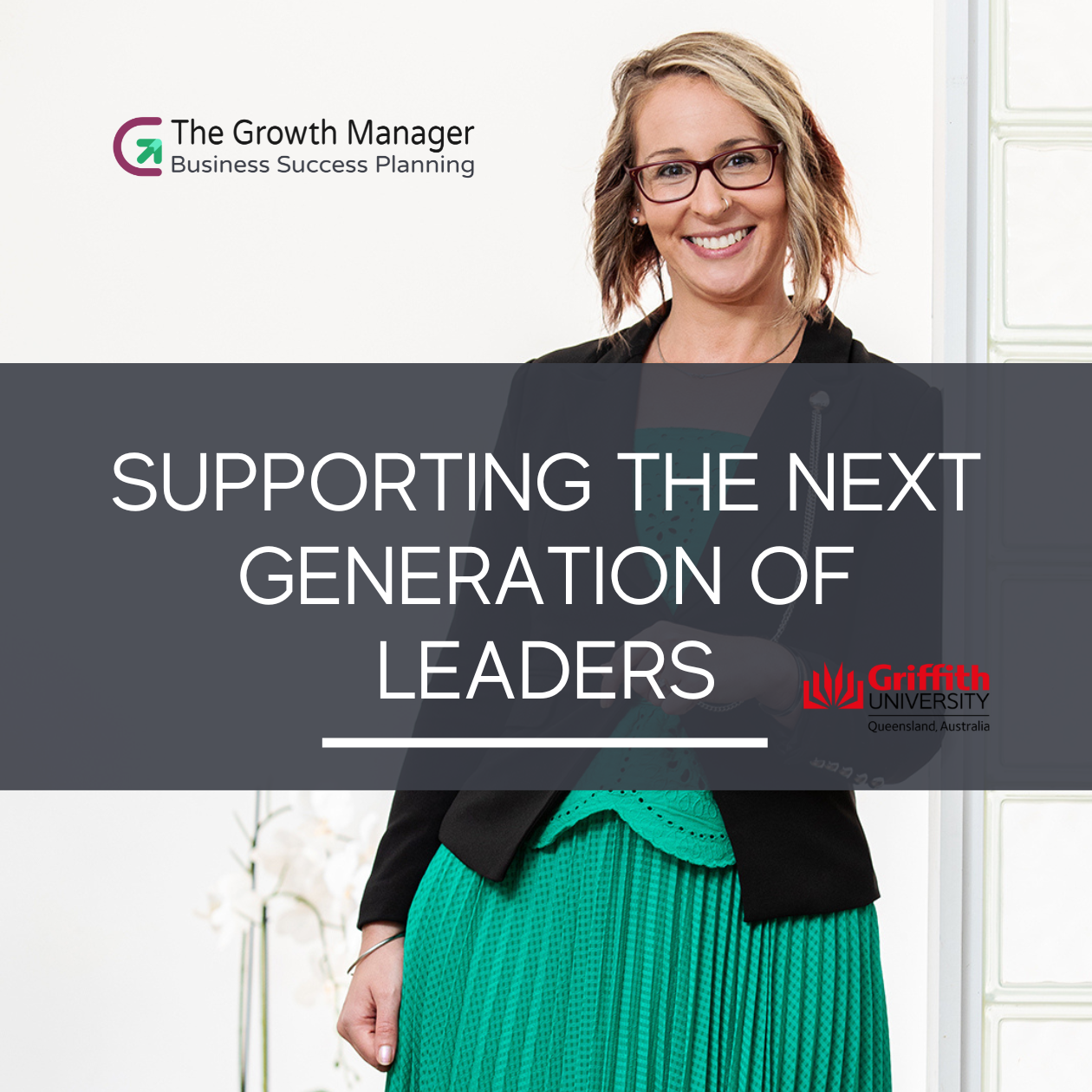
I mentor at Griffith to show that real business growth is about impact, not invoices.
My involvement with Griffith University’s Creating Better Business program centres on making a meaningful impact—a theme that continually drives my professional journey. This work isn’t billed or branded; it is a deliberate contribution. That deliberate choice holds real significance for me—and it connects directly to how I approach my business and mentoring philosophy.
As the founder of The Growth Manager, I make mentoring the core of everything I do. I work daily with service-based founders and SME owners. They are building businesses while navigating growth, overwhelm, capacity constraints, and big ambition. So when the opportunity arose to volunteer as an Industry Mentor in Griffith Business School’s Creating Better Business program, the decision felt natural. This seamless alignment between my passion for purposeful impact and the program’s mission made my choice clear.
It’s helpful here to introduce the Creating Better Business Program and its real-world depth.
The Creating Better Business program is a 12-week course at Griffith Business School where final-year business students work with real industry partners on live consulting projects, guided by structured onboarding, clear expectations, and regular mentoring.
Instead of working on simulations, students collaborate on actual projects for businesses, tackling genuine challenges and applying classroom learning to real situations.
Each trimester includes:
- A formal onboarding process for Industry Mentors and clients
- A structured expectations framework outlining responsibilities across students, mentors, and industry partners
- Weekly mentoring touchpoints
- Academic coaching support
- A final presentation delivered directly to the client
The Industry Mentor’s job is to help students think for themselves rather than provide all the answers.
During onboarding, we learned that coaching helps students link what they learn in class to real situations. It is better than just giving quick answers.
- We avoid providing templates without context.
- We build capability.
- We strengthen decision-making.
- We develop strategic thinking.
Why Volunteering Matters to Us
At The Growth Manager, we believe business should be done with purpose. That means giving back. Helping future business leaders is not just about feeling good. It is a smart, long-term way to support the whole business community.
The students sitting in those lecture theatres today will be:
- Founders
- Consultants
- Board members
- Senior leaders
- Policy influencers
If we help students think about sustainable growth now, we can shape how business works in the future. That is why volunteering in this program matters to me. Here’s what I believe:
- I believe coaching creates stronger leaders than instruction, which means your future hires and teammates arrive ready to innovate rather than just follow directions.
- I believe purpose-led businesses deserve strategic support, so your organisation gets more than just goodwill; it gains practical tools and insights to fuel real growth.
- I believe young professionals thrive when they are given real responsibility, giving your team members the confidence and capability to step up sooner and drive results.
Importantly, this experience offered a dual benefit: not only did I support students’ learning, but I also had the privilege of backing a client’s business and making meaningful change.
The Industry Client: CareCallingNow
My student group was assigned to work with CareCallingNow, a social enterprise that provides automated well-being check-in calls for vulnerable Australians.
CareCallingNow supports:
- Seniors living independently
- People with disabilities
- Individuals who may be socially isolated
Automated daily check-in calls trigger support if unanswered.
CareCallingNow was founded by Irene Irene and Ian Manson after they saw firsthand how isolation can impact the well-being of vulnerable Australians. Motivated by a personal connection to seniors living alone, they launched the social enterprise to provide automated daily check-in calls and ensure no one falls through the cracks. I really admire how they combine purpose with practical solutions. Like many new, purpose-driven businesses, they faced significant challenges as they tried to grow. If required, students were to explore:
- AI integration within CRM systems
- Automation refinement
- Funnel optimisation
- Affiliate and partnership strategy
- Market positioning and scalability planning
This experience went beyond a typical classroom exercise. It involved supporting a business whose mission drives positive change while fostering responsible growth.
Watching Students Move From Theory to Strategy
In week one, most students approach the project with enthusiasm but little context.
- Their thinking is broad.
- Their ideas are plentiful.
- Their structure is still forming.
That is normal. What I enjoy most about this program is seeing that change happen. With regular mentoring, coaching, and teamwork, you start to notice:s deepen.
- Assumptions get challenged.
- Ideas become frameworks.
- Frameworks become actionable roadmaps.
The program emphasises professionalism, communication standards, and ethical responsibility.
Students are expected to:
- Develop project contracts.
- Lead meetings with industry clients.
- Deliver structured presentations.
- Translate theory into measurable recommendations.
This is real-world experience, and the progress students make in 12 weeks is impressive. The real turning point came in Week 8, when the students fully led the client meeting, guiding the discussion and owning their recommendations without any prompting from me. I watched them shift from uncertainty to confident problem-solvers right in front of their client, and that was genuinely powerful.
One of the student teams working with CareCallingNow won the top award for their presentation and concept. I was so proud—not just because they won, but because of how much they grew and moved beyond basic ideas to:
- Clear strategic segmentation
- Structured automation mapping
- Practical implementation timelines
- Risk-aware growth planning
- Client-sensitive communication
Their final presentation was confident, well-organised, and realistic. They showed exactly what we hope to achieve through mentoring: clarity, strategy, confidence, and practical application.
Seeing them get recognised for their work was very rewarding. It reminded me of what I see with my own clients every day: when people are challenged in the right way and given good support, they step up.
What This Reinforced for Me as a Mentor
Mentoring students within this program reinforced several truths I hold firmly:
- Coaching unlocks deeper thinking than instruction.
- Strategy must be practical to be valuable.
- Sustainable growth requires structure.
- Confidence follows clarity.
It also reminded me that young leaders can do much more than they think. How often do you treat interns or junior team members as full professionals? Pausing to reflect on our own leadership habits helps us all grow. When you treat students like professionals, they rise to the expectations. We do the same in the Growth Manager mentoring sessions. We treat clients as capable decision-makers. WWE refines their thinking, challenges its blind spots, and strengthens its system. We do not build dependence. Most importantly, we build capacity.
Why This Program Aligns With The Growth Manager’s Mission
The Growth Manager exists to help entrepreneurs build businesses that fit their lives, not consume them. To bring this mission into your day-to-day work, I encourage you to pick one area of your business to simplify this week—maybe it’s streamlining a process, decluttering a workflow, or setting aside time for strategic reflection. Even one small change can help your business serve your life, not run it.
That includes:
- Sustainable systems
- Strategic prioritisation
- Ethical leadership
- Capacity-aware growth
The Creating Better Business program reflects these same values. It emphasises:
- Professionalism
- Accountability
- Critical thinking
- Collaboration
- Real-world application
This program connects what students learn in class with real business practice. It reminds me why mentoring matters at every stage—from student to founder, and from new entrepreneur to experienced leader. Growth does not just happen; it is planned.
Signing Up Again
At the end of the trimester, I did not hesitate.
I signed up to mentor for another semester. Every bit of impact adds up over time.
Each new cohort brings:
- Fresh thinking
- New industry challenges
- Different business models
- Evolving market dynamics
Each cohort brings new opportunities to shape tomorrow’s business leaders and clients. Mentoring is a lasting commitment, and with every new group, I’m motivated by the difference we can make together. Investing in people early means contributing to the industry’s future.
Why This Matters to You
If you are reading this as a service-based founder or SME owner, here is what I hope you take away:
- Business is not just about growth metrics.
- It is about contribution.
- It is about leadership.
- It is about lifting the standard of thinking within your industry.
Supporting Griffith University’s Creating Better Business program is one way I put that belief into action. It is the same approach I use with my clients: people come first, strategyleads, everything is practical, and sustainability is always in focus.
If you want to build a business that grows responsibly, scales intentionally, and contributes meaningfully, that is our work. It is not about being louder. It is powerful to watch a group of students present their strategies to a real client. You see nerves. You see growth. You see courage. Nerves are the runway for growth. That moment of stepping up, feeling the pressure, and pushing through is where deep learning happens—and where lasting confidence begins. It is a good reminder that the best part of business is helping others build their skills.
I am thankful to Griffith Business School for letting me be part of this. I am proud of the students who took on the challenge, and I look forward to helping the next group of future business leaders.
The future of business should be strategic, ethical, and sustainable. It should be built by people who know that growth is about more than just making money.
It is about responsibility.
What contribution will define your growth legacy?